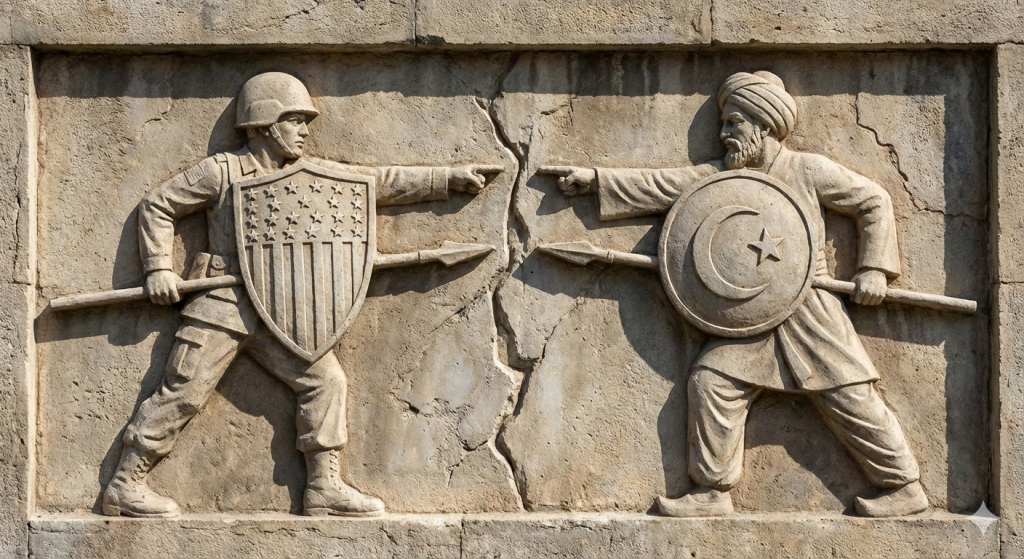
The warning lights are flashing across the Middle East. In the waters of the Persian Gulf, American aircraft carriers steam alongside their battle groups while Iranian Revolutionary Guard vessels conduct provocative maneuvers near the Strait of Hormuz. In the skies above, F-35 and F-22 stealth fighters have been streaming into regional bases for weeks. And in the diplomatic corridors of Geneva and Oman, negotiators are making last-ditch efforts to prevent what increasingly appears inevitable: a military confrontation between the United States and the Islamic Republic of Iran.
"We're going to make a deal or get a deal one way or the other," President Donald Trump told reporters in mid-February, setting a roughly two-week timeline for Iran to accept American terms . When pressed on what "the other way" might entail, the president was characteristically blunt: "Bad things will happen" .
The Nuclear Impasse
At the heart of the current crisis lies the long-simmering dispute over Iran's nuclear program. The 2015 nuclear deal, formally known as the Joint Comprehensive Plan of Action (JCPOA), was abandoned by Trump during his first term. Subsequent efforts under the Biden administration to revive the agreement failed. Now, with Trump back in the White House, the administration is demanding a new and significantly tougher accord .
The American position, as articulated by Vice President JD Vance following talks in Geneva, is that Trump has established "red lines that the Iranians are not yet willing to actually acknowledge and work through" . These red lines reportedly include not only stringent limits on enrichment but also constraints on Iran's ballistic missile program and its support for regional proxy groups .
Iran, for its part, maintains that its nuclear research serves purely civilian energy purposes . Supreme Leader Ali Khamenei has threatened to respond to any American strikes with maximum force, warning in social media statements that Iranian forces could sink a US aircraft carrier and hit the American military "so hard that it cannot get up again" .
The Military Build-Up
What makes the current standoff different from previous crises is the sheer scale of American military power now assembled in the region. The United States has positioned two aircraft carriers—the USS Abraham Lincoln and USS Gerald R. Ford—in the Middle East, accompanied by a dozen warships, hundreds of fighter jets, and multiple air defense systems .
More than 150 military cargo flights have transported weapons systems and ammunition to forward positions . In a single 24-hour period recently, another 50 fighter jets—including F-35s, F-22s, and F-16s—headed to the region . Command-and-control aircraft, vital for orchestrating large air campaigns, are also inbound .
This represents the largest American military presence in the Middle East since the 2003 invasion of Iraq . Satellite imagery analyzed by Reuters shows Iran responding in kind, reinforcing nuclear and missile-linked facilities with concrete shielding and buried tunnel entrances . At the Parchin military complex, southeast of Tehran, images indicate what the Washington-based Institute for Science and International Security described as a "concrete sarcophagus" over a facility identified as Taleghan 2 .
What War Might Look Like
If diplomacy fails, the conflict could take several forms. According to sources familiar with the planning, Trump is reportedly weighing an initial "limited strike" targeting a few military or government sites—a step designed to pressure Tehran into an agreement without triggering full-scale war . If Iran still refused to comply, the US would then respond with a broader campaign against regime facilities, potentially aimed at toppling the Tehran regime .
However, many analysts warn that even a limited strike could rapidly escalate. "To significantly degrade Iran's ballistic missile capabilities, the US would have to strike hundreds of sites across the country, including mobile missile launchers that are inherently difficult to track and destroy," notes R Swaminathan, a former Governor of India to the International Atomic Energy Agency . If the objective shifts to overthrowing Iran's supreme leadership, the target list would expand further .
Israeli officials are preparing for a scenario of war within days and are advocating for a maximalist approach targeting not only nuclear infrastructure but also missile capabilities and potentially regime stability . Any future campaign is expected to be more extensive than last year's 12-day conflict, during which the US joined Israeli strikes on underground nuclear facilities .
The Regional Dimension
Unlike Iraq in 2003, Iran is not isolated. The country has forged closer ties with both Russia and China in recent years. Joint naval exercises involving all three nations are planned soon in the Strait of Hormuz . Russia is helping Tehran with equipment for jamming communications and has agreed to a secret €500 million arms deal to provide advanced shoulder-fired "Verba" missiles—a significant effort to rebuild air defences shattered during last year's war with Israel . China remains Iran's biggest oil customer and has sold ballistic-missile components in recent years .
Perhaps more significantly, key US partners in the Gulf have reportedly informed Washington that they would not permit their territory to be used as launch platforms for an attack on Iran . Iran has further warned that it would retaliate against any country that supports a US military operation, raising doubts about whether Washington could secure necessary overflight rights .
The European position also presents constraints. Governments across the continent have signalled reluctance to support offensive operations, and the United Kingdom has refused to allow the US to use its airbases to mount strikes against Iran . The United Nations Secretary General António Guterres has urged diplomacy .
Economic Stakes: The Strait of Hormuz
Any military conflict would have immediate and severe economic consequences. Iran sits atop approximately 4.7 million barrels per day of oil production, accounting for roughly 4.4 percent of global supplies . But its true strategic significance lies in its geography: Iran controls the northern coastline of the Strait of Hormuz, a narrow 21-mile waterway through which around 20 percent of the world's oil and liquefied natural gas must pass .
"If a conflict breaks out, Iran may attempt a blockade of the Strait of Hormuz, which would stop the flow of around 20 percent of the world's oil," warns Ajay Singh, a management advisor and former Shell executive . Iran has already demonstrated its ability to disrupt this route, partially closing the strait for several hours in February 2026 to conduct military exercises .
The price implications would be severe. Brent crude, already elevated by tensions, could rapidly climb toward $80 per barrel in a limited conflict scenario. A prolonged closure would send prices much higher. Bob McNally, founder of Rapidan Energy and former White House energy advisor, warns that prices would likely exceed $100 per barrel, curbing demand and potentially precipitating an economic downturn .
For Americans, these costs would arrive first and most visibly at the gasoline pump—at a politically precarious moment with midterm elections due in nine months .
Domestic Constraints
Within the United States itself, significant constraints on military action exist. Polling shows Americans remain wary of foreign conflicts. A Reuters/Ipsos poll in January found 69 percent of Americans agreed the US should only use its military when facing a direct and imminent threat .
Moreover, reports indicate tension between the White House and military leadership. According to insiders, Joint Chiefs Chairman Dan Caine has privately delivered a cautious assessment to the president, warning that even a limited strike against Iran would carry serious risks, including American casualties, depleted weapons stockpiles, and the potential for escalation into a far more complex conflict .
"Senior commanders have warned explicitly that any operation against Iran—ranging from limited strikes to large-scale air campaigns—would entail 'significant risks' and could draw the United States into a protracted war of attrition," notes an analysis from DID Press Agency .
Senate Democratic Leader Chuck Schumer has also raised concerns about the lack of public debate. "First and foremost, if they want to do something in Iran—and who the hell knows what it is—they should make it public and discuss it with the public and not keep it secret," Schumer told reporters . "When you do these military operations in secret, it always causes longer wars, tragedy, more expenses and mistake(s)."
The Historical Lesson
For those who remember 2003, the parallels are both striking and unsettling. Then, as now, Washington issued stark warnings about weapons of mass destruction. Then, as now, the intelligence appeared to support urgent action. Then, as now, the assumption was that military force could achieve political objectives relatively cleanly.
But as Manal Lotfy writes in Al-Ahram Weekly, "A war with Iran would not resemble Iraq, and it would be more complex, more costly, and potentially far more destabilising" . Iran is nearly four times the size of Iraq and home to more than 90 million people. Its security architecture has been forged in decades of confrontation with Washington. Its doctrine is asymmetric by design, relying on ballistic missiles, drones, cyber operations, and regional proxy networks rather than conventional confrontation .
"The proposition that Arab states would willingly submit to Israeli dominance in exchange for the promise of an American security umbrella has proven to be fundamentally flawed," one Arab diplomat based in London told Al-Ahram Weekly .
The Coming Days
As of late February 2026, the third round of indirect talks between Iran and the United States is underway . US officials have given Iran a two-week window to present a detailed proposal following the latest Geneva negotiations . Tehran has signalled that it hopes to reach a fast agreement to prevent what it calls an unnecessary and disastrous war, yet it has also made clear that it is prepared for conflict if diplomacy fails .
Polish Prime Minister Donald Tusk has urged all Polish citizens in Iran to leave the country immediately, warning that evacuations might not be possible within "dozens or several dozen hours" . US military officials have briefed President Trump that forces would be ready for action by late February .
In his recent State of the Union address, Trump outlined his case for possible action, citing Tehran's support for militant groups, its handling of protesters, and its missile and nuclear programmes as threats to the region and the United States . But he also expressed a preference for peace: "As president, I will make peace wherever I can, but I will never hesitate to confront threats to America wherever we must" .
Whether those words signal a genuine commitment to diplomacy or merely the rhetorical prelude to conflict may become clear in the days ahead. For now, the world watches and waits—acutely aware that in the narrow waters of the Persian Gulf, in the hardened facilities beneath Iranian mountains, and in the command centers where strikes are planned, the future of the region is being decided.