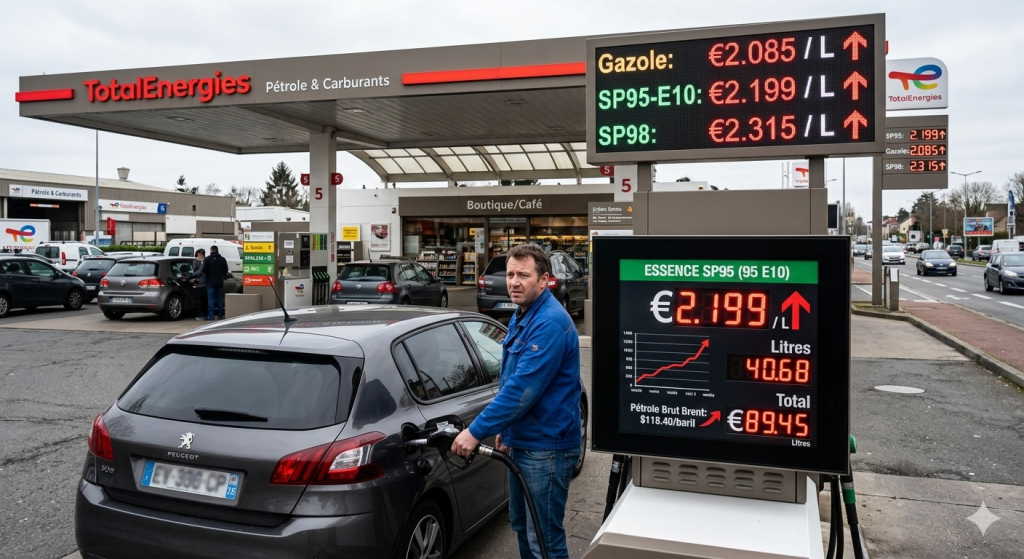
Just weeks ago, oil analysts predicted a year of relative stability. Today, that outlook has been shattered. Brent crude, the international benchmark, has surged past $90 per barrel, flirting with the $100 mark last seen during the initial shock of the Ukraine war. The reason is singular: the rising probability of a military confrontation with Iran, a member of OPEC and one of the world's most strategically vital energy producers.
While no missiles have yet been fired at oil infrastructure, the market is already pricing in a "war premium." This is the cost of hedging against the chaos that would engulf the region if the current nuclear stalemate turns hot.
The "Fear Factor" vs. Actual Supply
Initially, the market's reaction was muted. Traders have grown accustomed to saber-rattling in the Gulf. However, the recent build-up of US naval assets, combined with Iran's explicit threats to close the Strait of Hormuz if attacked, has transformed background noise into a five-alarm fire.
"We are not yet seeing a physical shortage of barrels, but we are seeing a massive shortage of confidence," explains Giovanni Staunovo, a commodity analyst at UBS. "The market is terrified of the 'what if.' What if Iran mines the Strait? What if the US enforces a stricter blockade? That uncertainty alone is adding $5 to $10 a barrel."
The Strait of Hormuz, a narrow maritime passage between Oman and Iran, is the world's most important oil artery. A fifth of global oil consumption—roughly 17 million barrels per day—passes through it. For Saudi Arabia, the UAE, Kuwait, and Iraq, the strait is the only way to ship their crude to world markets.
Iran has repeatedly threatened to close the strait in retaliation for any military action. While Tehran likely has the capability to disrupt shipping using mines, fast-attack boats, and missiles, most analysts believe a permanent closure is unlikely. However, a single limpet mine striking a tanker, as seen during the 2019 "Tanker War," would be enough to send insurance rates skyrocketing and cause shippers to pause operations, effectively creating a bottleneck without a formal blockade.
Iran's Own Oil: The Return of the Sanctions Wild Card
Beyond the transit threat, there is the question of Iran's own oil supply. Despite US sanctions, Iranian crude exports have surged to multi-year highs in 2024, with much of the flow heading to China. This soft underbelly of the sanctions regime has helped keep global markets relatively well-supplied.
A direct conflict would change that instantly.
Military Strikes: If the US or Israel strikes Iranian facilities, Tehran's ability to export could be crippled overnight, removing roughly 1.5 to 2 million barrels per day from the market.
"Maximum Enforcement": Even without strikes, a new "maximum pressure" campaign in a war footing could lead to the US Navy actively interdicting Iranian tankers, achieving what diplomacy could not: a near-total halt to Iranian oil sales.
The loss of Iranian barrels alone would be painful but potentially manageable for OPEC+, which holds millions of barrels of spare capacity, mostly in Saudi Arabia and the UAE.
The Contagion Effect: What if the Neighbors Get Hit?
This is the nightmare scenario for the trading floors. An Iran-Israel or Iran-US conflict has a high probability of drawing in Iranian proxies and allies. In recent weeks, rhetoric has intensified regarding potential strikes on Saudi or Emirati oil infrastructure.
In 2019, Iran claimed responsibility for drone attacks on Saudi Aramco's Abqaiq and Khurais facilities, temporarily halving the Kingdom's oil production. If the region tips into war, such attacks could become systematic.
"The real risk to the oil price is not just Iran; it's the potential for a regional conflagration that takes out supplies from the entire Gulf," said a senior oil trader based in Geneva. "If Saudi Arabia gets dragged in, and their facilities are hit, we aren't looking at $100 a barrel. We are looking at $150 or even higher, and a global recession."
The Domestic Paradox: High Prices Help Tehran
There is a bitter irony in the current market dynamics for the West. The high oil prices driven by war fears are providing a financial lifeline to the Iranian government. Even as the regime faces domestic unrest and a crumbling economy, the increased revenue from the oil it is managing to sell helps fund its military and proxy networks.
For the Biden administration, which has struggled to manage inflation, a sustained oil shock would be politically damaging. It presents a cruel choice: tolerate a nuclear-capable Iran, or risk a price spike that punishes American consumers and destabilizes the global economy.
What Happens Next?
The oil market is now a prisoner of the negotiations in Geneva. If a diplomatic solution emerges, the "war premium" could evaporate as quickly as it appeared, sending prices tumbling. However, if talks collapse and military action is perceived as imminent, the price of crude will not just rise—it will become volatile, unpredictable, and potentially devastating for the world economy.
For now, every statement from a general, every movement of a warship, and every headline from the region is being translated into dollars and cents on screens from New York to Shanghai. The world is paying the price for peace, and bracing for the cost of war.