

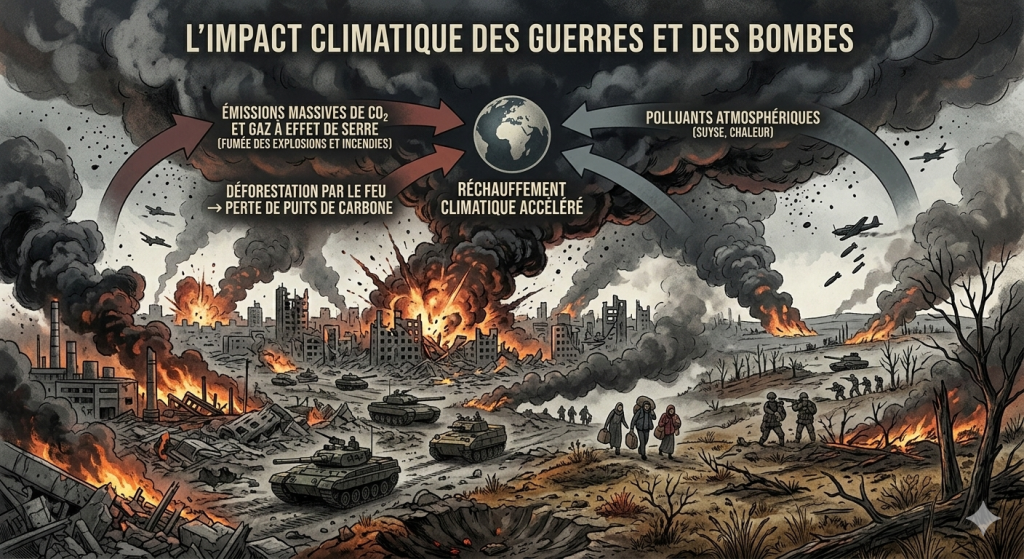
The relationship between conflict and climate is a deadly feedback loop. Climate change can drive resource scarcity and instability, increasing the risk of war . War, in turn, is a prolific emitter of greenhouse gases. Yet, under international climate agreements like the Paris Accord, military emissions are largely exempt from reporting requirements, rendering them a blind spot in global decarbonization efforts . As the world teeters on the brink of another Middle Eastern conflict, experts are warning that we cannot afford to ignore the "carbon cost" of warfare .
Table of contents [Show]
The Military's Massive, Unchecked Footprint
To understand the climate impact of a potential war with Iran, one must first look at the peacetime footprint of the militaries that would be involved. Globally, armed forces are responsible for an estimated 3.3% to 7% of total global greenhouse gas emissions . If all the world's militaries were combined into a single country, they would rank as the fourth-largest emitter on the planet .
The United States military, which would be at the forefront of any major conflict with Iran, is the single largest institutional consumer of fossil fuels on Earth . Its fleet of fighter jets, bombers, and naval vessels are carbon-intensive machines. A single F-35 fighter jet, for example, burns approximately 5,600 liters of fuel per hour, emitting over 13 metric tons of CO₂ in that time . A B-2 Spirit bomber, the kind used in recent strikes on Iranian nuclear sites, carries a significant carbon cost with every mission .
The recent spike in global military spending, which reached $2.7 trillion in 2024—the largest increase since the Cold War—directly correlates with rising emissions . When NATO members discuss increasing defense spending, it translates to more tanks, more jets, and more fuel burned, further inflating the military's carbon budget .
The Scorched Earth: Direct Environmental Impacts of Strikes on Iran
The June 2025 strikes on Iranian nuclear and military facilities offer a stark case study in the immediate climate damage of modern warfare . When missiles and bombs hit industrial sites, they do not just destroy buildings; they create toxic, carbon-belching infernos.
Following the strikes on Iran, local media reported that attacks on oil depots near Tehran released an estimated 47,000 tons of greenhouse gases into the city's atmosphere in a single event . Major fires broke out at oil refineries and fuel depots, releasing a complex mix of pollutants, including particulate matter, nitrogen oxides, carbon monoxide, and volatile organic compounds .
The munitions themselves are also polluters. Missiles release substances like aluminum oxide and black carbon into the upper atmosphere, and some components can even contribute to ozone layer depletion . The bombs used in modern warfare, such as the 30,000-pound GBU-57 "bunker busters" reportedly deployed against Iranian nuclear sites, require massive amounts of energy to produce, transport, and deploy .
The "Invisible" Emissions and a Vulnerable Landscape
Beyond the immediate smoke plumes, a conflict with Iran would trigger a cascade of climate-related consequences.
Infrastructure Reconstruction: The emissions from rebuilding destroyed power plants, water treatment facilities, and urban centers are classified as "reconstruction emissions." Based on studies of other conflicts, these can account for over a quarter of a war's total carbon footprint .
Landscape Fires: Warfare increases the risk of landscape fires. In Ukraine, for example, front-line fighting tripled emissions from forest fires . Iran's unique and ancient Hyrcanian forests, already stressed by drought, would be at extreme risk .
Water and Soil Contamination: Toxic substances from bombed industrial sites seep into groundwater and soil, damaging ecosystems and rendering agricultural land unusable . In a country like Iran, where over 90% of water is used for agriculture and major dams near Tehran are critically low, this further destabilizes the population and the environment .
A Country on the Brink of Ecological Collapse
The climate impact of a war with Iran is doubly tragic because the country is already on the verge of environmental collapse. Even without war, Iran is facing one of the worst water crises in its history. Dams near Tehran are at their lowest levels in 70 years—the Karaj dam, a major water supplier, is 86% empty . The capital is sinking due to the over-extraction of groundwater, and iconic lakes have turned into beds of salt .
War would pour fuel on this fire. By targeting the remaining infrastructure, disrupting environmental management, and diverting resources away from adaptation, conflict accelerates the very desertification and resource depletion that drive instability. As one expert noted, addressing the climate crisis requires confronting the military structures that sustain our reliance on oil and gas .
The Legal and Moral Vacuum
Currently, there is no binding international treaty that adequately protects the environment during armed conflict, and no mechanism to hold nations accountable for the climate damage of their wars . While the UN Environment Programme warns that environmental damage from conflicts pushes people "into hunger, into disease and into displacement," the emissions from the bombs and jets continue to rise .
Some experts and activists are calling for the integration of military emissions into climate frameworks and for "climate reparations" to account for the destruction . The question remains: as the world faces a narrowing window to limit global warming to 1.5°C, can we afford to treat the carbon footprint of war as an acceptable cost of doing business? .
As the US and Iran navigate their current standoff, the stakes are clear. A war would not only devastate lives and livelihoods in the immediate term but would also push the planet further past its ecological tipping points. In the 21st century, the smoke from a bombed refinery is not just a symbol of conflict; it is a direct contribution to a global climate crisis that recognizes no borders.